Showing posts with label drug costs. Show all posts

Canada, the US, and the Cost of Cholesterol Lowering Medications


Today’s Managing Health Care Costs Indicator is $364 million

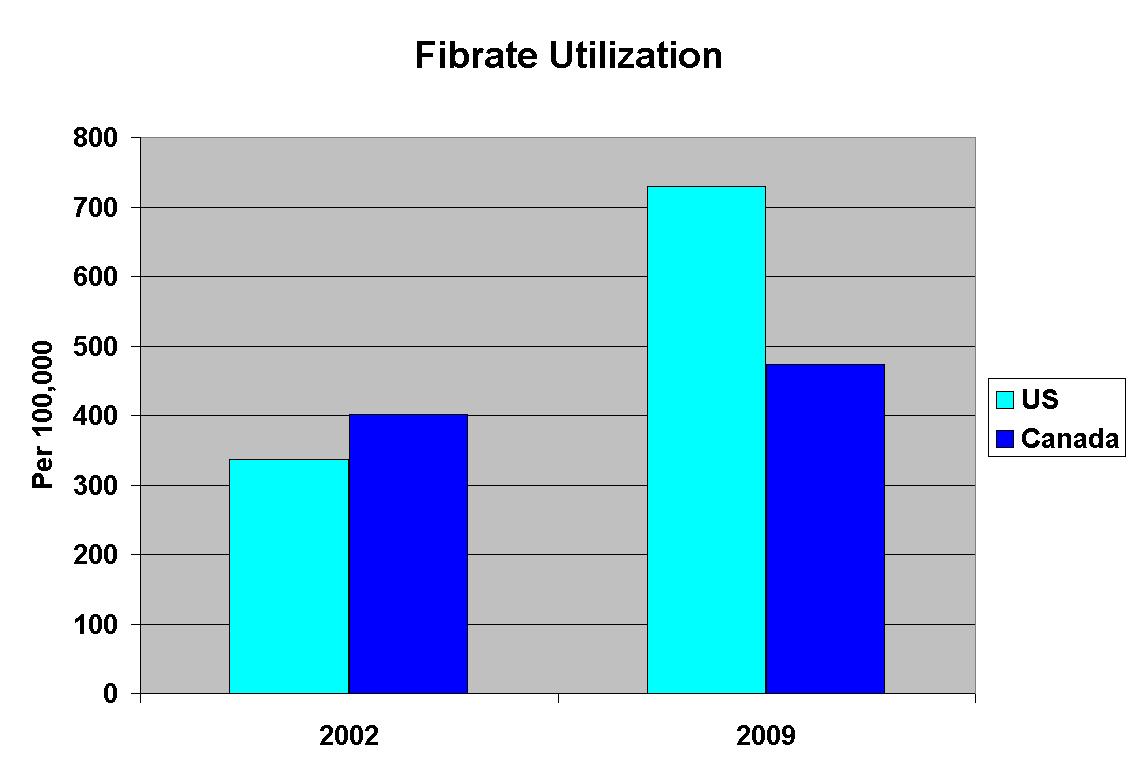
This week’s JAMA  has an article with graphics that tell an important story.

Recent studies have questioned the value of the newer, brand name fibrates to lower cholesterol – but nonetheless fibrate use has increased, especially in the US. 
  
In the United States, the entire increase is in the expensive brand name medicine, not the generic medicine which has a better-established record of effectiveness.

In Canada there has been a tiny increase in the use of fibrates – but that increase is almost entirely in generic medication

Here is the price implication.


The US is one of the only developed countries that does not regulate pharmaceutical prices. We’re one of the few countries that allows direct to consumer advertising.  If our physicians prescribed generic fibrates at the Canadian rate, even with our high number of prescriptions, this class of medicine would have cost $364 million less in 2009.

A side note: This week's JAMA also has a review I wrote of Walter Bortz' Next Medicine.  Harvard Link.  Non-Harvard Link 

Don't Restrict Mail Order Drugs


Today’s Managing Health Care Costs Indicator is 5.2%


Local pharmacies were probably overjoyed at an article in last week’s New York Times  about their efforts to make mandatory mail order prescriptions illegal.  Legislative efforts are underway in NY and PA to require that health plans offer consumers a choice of mail order or local pharmacy for maintenance medications.   

There have been enormous changes over the last two decades in local pharmacies.  In the late 1980s when I started in clinical practice, there were over a dozen sole-proprietor independent pharmacists within a few miles of my office in Belmont, Massachusetts.    They did well by their communities – they knew their patients who had chronic diseases, they advocated to be sure their patients wouldn’t miss any doses of medicine, and they supported local high school sports teams and helped build local town pride.

Two of these pharmacies are still in business; one also sells durable medical equipment, and I’m not sure how the other has overcome the wave of consolidation in the local pharmacy business.

If you had asked me in 1987, I would have told you that these local pharmacists were the foundation of health care in our community.  I’ll always remember the day the pharmacist in Waverly Square opened his pharmacy up for me on a Sunday when a terminally ill patient had run out of sustained release morphine.   Without his intervention, my patient would have had to be ambulanced to the hospital.

But times have changed. There are now two 24-hour CVS stores within 3 miles of my old office.  The old, cottage-industry, highly-personalized independent drug stores provided exceptional care – but they did it exceptionally.   They were there for the rare situations where they had to come in during off hours – but that wasn’t advertised as available to everyone – even those who were not well-connected to the health care system.

Now, even the CVS on the corner is being disrupted.  Giant robotic warehouses can dispense medicines for less – and they do it with a higher level of reliability than pharmacists at a local store who are being pulled in many directions at the same time.   

The Times article focuses on the convenience of local pharmacies. But it’s hard to remember to go to the pharmacy –even the 24 hour pharmacy – every thirty days.   Ninety day mail order prescriptions are associated with a higher medication possession ratio, and thus higher patient adherence.

The scale advantages to mail order that are compelling.  Medco, one of the large pharmacy benefit management companies, reports that the annual cost increase for employers with under 50% mail order was 5.3% in 2009, compared to an annual trend of 0.1% for those employers with over a 50% mail order rate.  There were other differences between the employers – but the cost savings from mail order are real.

Local pharmacies, mostly the national chains, aren’t going away. Many patients need a medicine today, many drugs are prescribed for a limited course, and adjustments of even maintenance drugs are often better made with small numbers of pills dispensed.   But I hope that legislatures will not stand in the way of moving maintenance prescriptions to mail order houses, which can improve adherence and save money.
Variation in Practice: Rosiglitazone Case Study

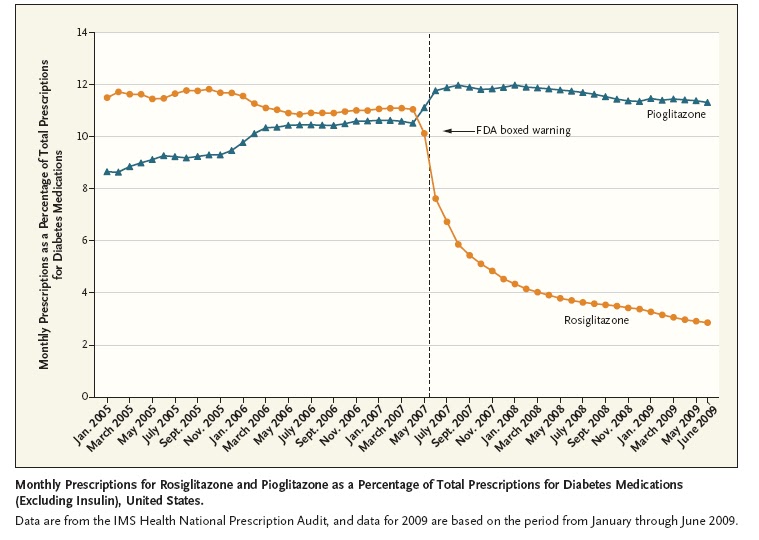
Rosiglitazone, a drug used for treating diabetes, has been shown in recent studies to be highly associated with increased risk of cardiovascular complications. While it's effective lowering blood sugar and helping patients attain a good hemoglobin AIC, which is how we judge diabetes control, it appears to increase the chances of a bad outcome.

The initial study showing that this medicine appeared to be 'trouble' was a metaanalysis published in 2007, and accompanied by an FDA "black box" warning.  The good news is that this new information and warning was associated with an impressive ~45% drop-off in drug utilization.  We often worry about the slow pace of incorporation into practice of new information.  In this instance the communication around the dangers of rosiglitazone looks like a big success.
click to enlarge 

These images come from an article in the New England Journal of Medicine on November 25. 

Here's a worry though.  Look at the geographic variation of use of this drug from 2005 to 2010.

Click image to enlarge 

The dropoff in rosiglitazone use is pretty uniform across the country- about 75% decrease in use for each quartile of previous utilization.  (The authors don't give state-specific data).  However, the northern plains and New England states had a low rate of use of this medicine in the first place -and maintained this over time.  Use of this (expensive) medicine represented an exceptionally large portion of diabetes medication costs in states including Idaho, Utah, Wyoming, Oklahoma, and Kentucky in 2005. Although these states used the highest amount of an exceptionally expensive diabetes medicine - they are not states known for differentially higher quality diabetes care.

This is another illustration of the Dartmouth Atlas contention.   Variations in overall cost usually don't purchase better quality - and sometimes purchase higher risk.