Showing posts with label Medicaid. Show all posts

The Continued Decline of Employer-Sponsored Health Insurance


Today’s Managing Health Care Cost Indicator is 53.5%


Click on image to enlarge. Source http://hschange.org/CONTENT/1280/
A report from the National Institute for Health Care Reform this week reports that 53.5% of Americans under 65 were covered by employer-sponsored health insurance in 2010 – a startling 10 point drop over only four years.  This continues a long term trend – almost 70% of Americans were covered by employer-sponsored health insurance in 2001. 

Employer-sponsored health insurance can decline for three reasons

  1.      Fewer people have been employed.
  2.      Fewer employers might offer health insurance.
  3.      More employees might decline employer-sponsored insurance, usually due to high employee premiums.


The Great Recession has reshaped all three elements of the employer health insurance market.  It will take us years (or decades) of growth to get back to employment levels that would have been predicted pre-Recession – and fewer jobs for applicants has meant a labor market where employees have more readily accepted poorer benefits – grateful just to have a job.   

More employees are working as independent contractors rather than full employees – and therefore ineligible for employer benefits.  Further, employers have felt enormous pressure to lower their costs –and with benefits (largely health insurance) often running an additional 30% of payroll, many employers have offered plans with lower benefits and higher employer premiums.  The higher premiums mean that more employees will opt-out –and be uninsured.

Government-sponsored insurance has picked up a substantial portion of the slack. Medicaid has increased from 9.5% of the population to 17.6% from 2001-2010, and even Medicare coverage has increased from 1.6% to 3% of the population (presumably more Americans who qualify for disability).    Still, the uninsured went from 14.1% to 19.5% of the population. (The 15% usually cited includes the elderly, who are nearly universally covered by Medicare).


Employers are advantaged purchasers of health insurance. They have a ready-made and stable group (sothey can spread risk across the population, and  it’s easier for actuaries to estimate future costs.)  They can enroll employees and families easily – lowering transactional costs compared to health plans enrolling individuals and small groups.

But employer-sponsored health insurance also causes “job lock,” where those with serious illness in their family are unwilling to change jobs for fear of insurance interruption.  This decreases labor flexibility – lowering overall growth and productivity. 

The decline in employer-sponsored health insurance illustrates the importance of establishing other ways to obtain health insurance.  These alternative means should have low transactional costs, and should allow substantial spreading of risk over the population.  That’s why we need health insurance exchanges to maintain access to health insurance and health care, and an individual mandate (or something close) to discourage the healthy from opting out.  

The nature of employment in the US has changed substantially, and the ACA allows the insurance market to effectively respond to these changes.  We’ll see what happens this week during Supreme Court arguments over the constitutionality of the Affordable Care Act.

Retrospective Emergency Department Denials: Treating the Symptom and Ignoring the Causes


Today’s Managing Health Care Costs Indicator is 3


Three states have recently enacted legislation or regulations to deny payment for Medicaid patients who are seen in Emergency Departments (EDs) for problems that are later believed to be non-emergent.  It’s easy to simply stop payment for services that are low value.  However, what our health care system really needs is better access for high value care, not cost shifting to try to prevent low-value care.

Inappropriate use of emergency departments is a common problem – and we think of this as enormously expensive Even adjusting for diagnosis, RAND researchers found that ED visits for four types of upper respiratory infections averaged $570, while office visits with the same diagnoses averaged $110. But that’s the allowed charge. Marginal costs for additional ED visits for minor concerns are actually quite small. (Here’s a post explaining this)

Not paying for ED visits based on after-the-fact diagnosis coding creates serious clinical concerns.  A “prudent layperson” might be pretty worried about chest pain – and might be surprised to get a $500 bill when the discharge diagnosis is “gastroesophageal reflux.”  Or a person with a heart attack might delay coming to an ED for fear that her symptoms weren’t serious enough –and could miss the narrow window to get a clot-busting drug or angioplasty to preserve heart muscle.    
People don’t go to the emergency room, in general, for convenience. They generally go to the ED because they don’t have a good alternative.   This is especially true for patients with Medicaid, who are far less likely to have primary care physicians.  Low Medicaid fee schedules have made access an enormous problem in many states.

Denying payment for ED visits based on discharge diagnosis is merely a cost shift – either to patients , or more likely to EDs and ED physicians, who  have little control over general ambulatory access.   Hospitals increasingly “own” large portions of the delivery system, so it’s reasonable to penalize hospitals which fail to create robust access for patients in their community.

We need new solutions to access – which should include more non-physicians and more tools to help patients evaluate the seriousness of their complaints.  Simply refusing to pay for ED visits without addressing the underlying problem will not lead us to a higher value health care system.

Health Growth Slows – Will We Lose Our Burning Platform?


Today’s Managing Health Care Costs Indicator is 3.9%


Click image to enlarge. Source 
Health Affairs just published the annual review of health care spending (from 2010) as calculated by the CMS Office of the Actuary.   The headline in the New York Times is “Recession Holds Down Health Spending,” and the Wall Street Journal says “Weak Economy Curbs Health Spending.” Total health care spending was up only 3.9% - and reached about $2.6 trillion. Overall increase in GDP was 4.2% - making this the first year overall GDP increased more than health care spending in my memory.

The study showed:
-        The effect of the Affordable Care Act on overall health care costs was 0.1-0.2% (by increasing access)
-        Hospital spending up only 4.9% (despite the aging of the population)
-        Professional services (mostly physicians) were up only 2.6%
-        Prescription drugs were up a measly 1.2% - reflecting more generic usage

Out of pocket medical spending was up only 2.8% - a surprise to me given that so many more families are covered by high deductible health plans. That’s an indication that many Americans have been deferring or foregoing health care that they would have received just a few years ago.

Increases by source of health care spending:
-        Employer Premiums: 6.3%
-        Out of pocket: 2.8%
-        Medicare: 7.0%
-        Medicaid: 9.2%


Government spending on health care is up – but don’t assume this means that government is less efficient. Rather, the Medicaid rolls went way up, and Medicare enrollment has increased as well as we continue to live longer and the baby boom ages in to Medicare. Ezra Klein had this graphic yesterday showing that effective inflation rate in government programs is considerably lower than that for private insurance plans.
Source 


We know separately that maternity rates are dramatically down as a result of the recession. These are likely to return to prerecession levels in the future – which will lead to increases in hospital and professional costs.
Source Click Image to Enlarge 

It’s heartening to see health care costs leveling off – but I hope that the sense of urgency in redesigning our health care system will not recede.  Health care still costs far too much, and we must make meaningful efforts to be sure we get more value from the health care system.  Health care is crowding out other important public investments, including education – which can have a larger long-term impact on population health and life than many of our health care system expenditures. And even if Medicare is relatively “efficient,” we can’t afford this program as my generation becomes eligible.

2010 was a good year in terms of health care cost increases.  However, this wasn’t the payoff from great efforts on health care reform; it was rather the consequence of a grim economy.  We’ll have to redouble our efforts to control costs in the environment of economic growth we hope for in the future. 

Cost shifting vs. Cost Saving

Ezekiel Emanuel has a commentary in the New York Times criticizing plans to convert Medicare to vouchers (aka ‘premium support.’ He reminds us that we really need to control costs – not merely shift them. Austin Frakt of The Incidental Economist has also just wrapped up a series on Medicare premium support – which points out that premium support could be designed so that it didn’t cost shift (although that seems unlikely given political realities).


We have a multi-payer system, and there are many opportunities to shift costs from one party to another. No value is created in the system by cost shifting. Private health plans and the government both practice robust cost-shifting in our system. They do this because it is far easier to shift costs than to genuinely lower costs.

The Affordable Care Act takes aim at some of the cost shifting in the current health care market. However, it does not do nearly enough. It’s possible that regulatory action alone won’t be the cure for cost shifting.

Let me review some additional examples of cost shifting in the US health care system:


Medicaid Underpayment

Medicaid pays quite low rates in many states to most providers – rate that are below the real cost of providing care. Providers bill extra to private insurers to make up this shortfall. The state balances its budget by cutting Medicaid provider payments, but this makes private health insurance in the state even more expensive. Employers who might benefit from a tax subsidy that forces budget cutbacks pay for the health care of the uninsured through a nontransparent extra fee added to their health care premiums. Voila. Costs are shifted.


The Affordable Care Act addressed a very small segment of this problem by fixing Medicaid primary care payments and Medicare rates for a limited period of time with full federal funding.

However, states continue to ratchet down Medicaid fees to address their current budget shortfalls. More cost shifting is in the wind.


Dependent Audits

Many employers have been performing audits to be sure that their employees are not enrolling ineligible dependents. That makes sense – why should the employer pay for an uncle or a godchild that is not an actual dependent? On the other hand, when ineligible dependents are removed, there is no cost saving in the health care system unless they no longer access care. The cost is merely shifted to another party – in some cases to ‘free care’ which is an invisible surcharge on all health care charges.


The Affordable Care Act specifies that children up to age 26 can stay on their parents’ health plan regardless of college status, work status, and even their own marital status. This is not very expensive – since the average cost of those between 18-26 is very low. It gets rid of a whole series of administrative hurtles to coverage – so that parents don’t have to get paperwork from their children’s college.


Medicaid Funding

Many states have developed ingenious ways to get the Federal government to pay for a larger portion of total medical care. Massachusetts managed to get Medicaid to fund replacement of a University of Massachusetts hospital fascade based on some fancy legislative dance in 2001.  In some instances, states agreeing to pay providers a higher fee (with the feds picking up more than half of the cost). Then, the states tax the providers to recoup some (but not all) of the excess costs. http://www.washingtonpolicy.org/publications/legislative/state-lawmakers-propose-using-phony-bed-tax-and-provider-tax-secure-more-fe The total cost of medical care goes up, but the state has constrained its own outlays.


Lifetime Limits


One thing that’s certain about hemophiliacs is that without blood factor concentrates they will have bleeding episodes, which can threaten their lives and cripple their joints. Many hemophiliacs require over $100,000 in biopharmaceuticals each year – so it’s easy to hit lifetime limits very quickly. This is a cost shift either to patients (few of whom could afford this) or more likely to state Medicaid programs, for which some hemophiliacs qualify if they hit the lifetime maximum in their employer-sponsored plan. The Affordable Care Act eliminated lifetime maximums as of this year – although there are still some employers who are “grandfathered” and will be allowed to maintain
Mini-Med Plans


These are health plans with very low premiums which pay benefits up to a very low total limit – as little as $5000 or even $1000. They are marketed to low-wage employees –often in retail or service industries, and often by companies that for competitive reasons simply can’t afford to pay the employer share of a more conventional health plan. The problem is that this is “upside down” insurance, which max out if a member has any significant illness at all. If a member gets leukemia – costs are not “controlled,” but are shifted to the patient, or again to state Medicaid plans if the member qualifies after hitting the employer plan maximum.


Raising Eligibility Age for Medicare

Austin Frakt has previously published data showing that raising Medicare eligibility age would save the federal government $5.7 billion, while it would cost individuals and businesses $11.4 million. A bad deal indeed.


Not all cost shifting is necessarily evil – and there are some examples which seek to change behavior by making health plan members responsible for a larger share of the costs.
For instance, reference pricing requires that health plan beneficiaries pay for any excess cost if they get elective care from providers who charge more than an allowed amount. These can save money for employers by shifting costs to the employees – but can also save money in the system by encouraging beneficiaries to choose lower cost providers. Reference pricing thus saves money for health plan sponsors through a mixture of cost shifting and actual cost saving.


Advocates also suggest that high deductible health plans save money through encouraging more responsible resource use. Studies have shown consistently that these plans do overall reduce utilization, but recent studies also suggest that these plans reduce both unnecessary and beneficial care.
Cost shifting will be a continued reality in our fragmented, multipayer system. Shifting costs to others is almost always easier than genuinely lowering health care costs, so we’ll need to continue to develop regulations to discourage cost-shifting. The Affordable Care Act is at least a start.

The managed care indicator will return with the next post. 

Oregon Medicaid Lottery Shows Benefit of Insurance


Today’s Managing Health Care Costs Indicator is 89,824


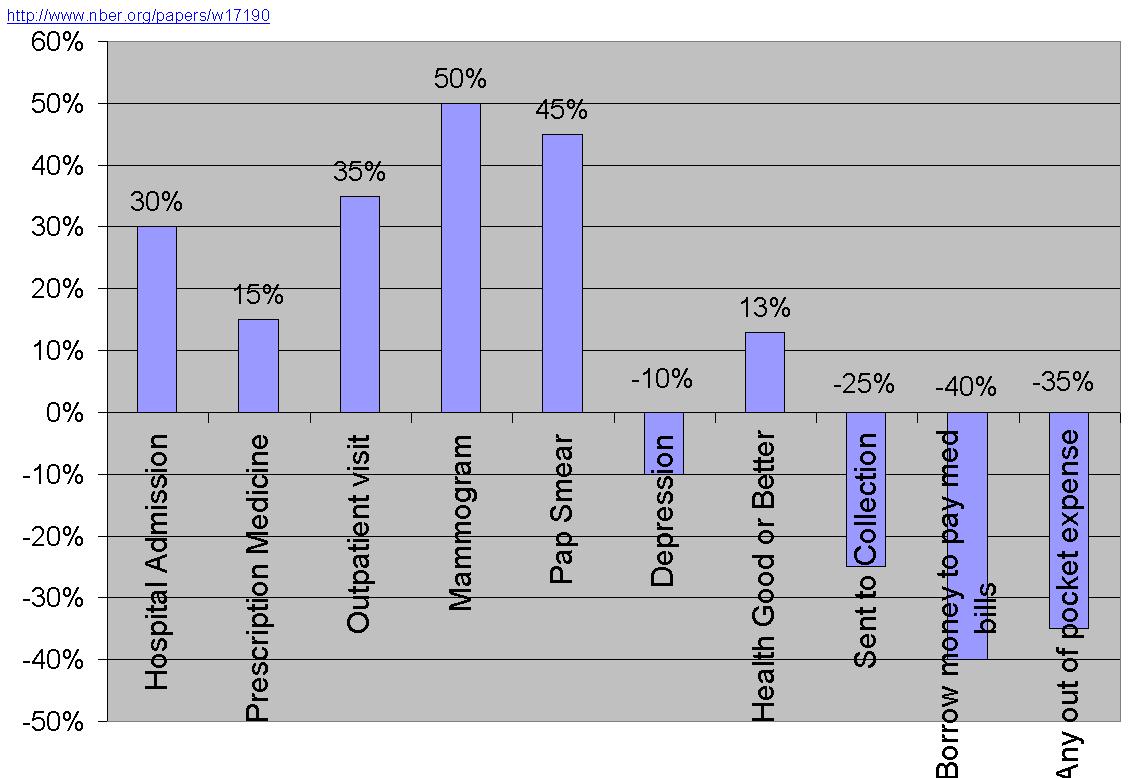
Click to enlarge.  Source 

Oregon realized it had resources to add about 10,000 beneficiaries to the Medicaid roles in 2008, and decided to hold a lottery to determine who would be awarded this Medicaid insurance.    89,824 Oregonians were eligible, 29.664 were randomized to be able to apply for Medicaid, and about 1/3 actually qualified.  (Reasons for not qualifying included not completing the paperwork or having income that was too high.).

Researchers at Harvard used this natural experiment to see what the impact of winning this Medicaid lottery really meant.   This natural experiment is ideal to determine the effect of gaining potential Medicaid eligibility – because the 30,000 who won the lottery (experimental group)  were randomly chosen, making it unlikely that they were significantly different than those who did not win the lottery (control group).

This is an especially important study because of the randomization, and because the researchers surveyed the experimental and control groups, and also looked at medical claims and credit reports to determine financial impact of insurance availability.


All of the conclusions are on an “intention to treat” basis – so that those who won the lottery but didn’t qualify for Medicaid are included in the “experimental” group. While this is necessary to make the “experimental: and “control” groups comparable, this approach likely  understates the effect of actually getting Medicaid because only 1/3 of the “experimental” group actually qualified for Medicaid.

What the researchers found

1)     People who won the lottery more care.  They don’t have fewer emergency department visits, they have more inpatient stays and outpatient visits.  It’s likely that there was some “pent up demand” from previous care foregone
2)     People who won the lottery have less life-changing medical debt. They are less likely to borrow money, and less likely to have a collection agency chasing them for medical debt.
3)     People who won the lottery get more preventive care
4)     People who won the lottery are more likely to report their health is good, and less likely to be depressed

The good news is that 16 million more Americans should be getting access to Medicaid as part of the Affordable Care Act.  There are, of course, two pieces of bad news.  Many states are chopping their current Medicaid programs, decreasing both eligibility and provider reimbursement.  Further, states are trying to wriggle out of their previous promises to expand Medicaid eligibility. Finally, many optimists though that having more people insured would lower medical costs – reasoning  that people could get treated early preventing high costs from detection of late stage disease.   The Oregon natural experiment is short – so it’s possible that this will become evident in the future. It’s unlikely though.   

Access to health insurance improves health and decreases financial stress.  It doesn’t save money. 

Federal Medicaid Spending Would Plummet Under Ryan Plan


Today’s Managing Health Care Costs Indicator is $243 billion


There's been a lot of attention on the potential impact of converting Medicare into a voucher program. There's been a lot less attention to the Ryan proposal to convert Medicaid into a block grant program and limit the federal government's contributions.

The Kaiser Family Foundation Commission on Medicaid and the Uninsured has released its analysis of the Ryan budget plan – which shows that the Federal payment to states for Medicaid would drop by about a third by 2021 – a decreased transfer of $243 billion in that year.

Medicaid covers 60 million Americans -- about 1/3 of all children in this country, and 40% of births.    However, it also covers 70% of all nursing home residents, and pays for their custodial care, which is not covered by Medicare and which the frail elderly can rarely afford based on their savings. The elderly “dual-eligibles” on Medicare and Medicaid represent 15% of Medicaid beneficiaries, but 40% of total Medicaid costs.

There are a limited number of actions states can take to address increasing Medicaid costs.

1)     Decrease number of people on the Medicaid rolls.   That’s straightforward – but the problem is that the really expensive Medicaid members, those with disabilities, severe psychiatric illness, and nursing home residents, simply cannot be removed from the program
2)     Decrease payment to providers.  Medicaid payment rates are already egregiously low in most states, and they’ve been cut further over recent months.  Medicaid beneficiaries already have a hard time finding a physician, and this could get even worse.  Hospitals already state that they have to shift costs to employer-based health plans because of low Medicaid rates. This is a special issue in some service lines like maternity – where across the country Medicaid pays for a quarter of all deliveries.
3)     Better manage the care of those on Medicaid.  That’s not easy – since the most expensive Medicaid members are so complex, have so many simultaneous illnesses, and are cared for in fragmented systems.  State Medicaid programs tend to be administratively underfunded, and their ability to invest in health management programs is severely limited.
4)     Transfer the risk for Medicaid beneficiaries to managed care companies.  The managed care industry has developed some good models to better care for those with complex illness, and there are some very competent companies that can manage Medicaid “risk” contracts.  This means less choice for Medicaid members, as these plans have strictly limited networks. It means new marketing costs and sometimes the requirement for profit margins, so states should be very careful to avoid allowing managed care companies to “skim” the healthiest Medicaid members.  It’s always more profitable to cherry-pick healthy patients than to better manage those at high risk.

Notice I haven’t mentioned “administrative savings” as a viable approach to solving states’ Medicaid crisis – the administrative costs tend to be low.   Some states probably overspend on qualifying Medicaid beneficiaries – although it’s cheaper to throw someone off the Medicaid rolls than to keep paying their bills.

States are still reeling from decreased tax revenue due to the Great Recession, and many are making substantial cuts in their Medicaid outlays already.  Medicaid is a lynchpin of decreasing the rate of uninsured in the country; the Congressional Budget Office estimates that under the Affordable Care Act an additional 16 million Americans would qualify for Medicaid.

The federal leverage over states to expand Medicaid access is based on funding, and if federal funding is plummeting, Medicaid rolls will shrink rather than swell.  Hence, this decreased funding would lead to a dramatic increase in the uninsured.  These proposed cuts will have a a very high cost in disruption of medical coverage for the most vulnerable. As such, they are bad social policy. 

Most Medicaid Expense is for Elderly and Disabled


Today’s Managing Health Care Costs Indicator is 70%

Governors all over the country are slashing Medicaid  – which represents a larger and larger portion of state budgets.  This is one of the largest challenges to the effectiveness of the Affordable Care Act.   Medicaid is supposed to cover an additional 16 million in 2014, and many states are going in the opposite direction.

Here’s the challenge.   Seventy percent of all Medicaid spending is on the elderly and disabled.  55% of all Medicaid spending is on long term care facilities, and Medicaid pays for almost half of all nursing home care in the country.  This information all comes from the Kaiser Family Foundation Medicaid Resource Book . Table of contents  Financing chapter 

SO – while 75% of the population on Medicaid is kids or nondisabled adults (often young parents), only 30% of the dollars are spent on this group of enrollees, even including costs of pregnancy and delivery.   Slashing Medicaid won’t save that much money if the target of the cuts are the nonelderly nondisabled.

A few charts to make the point.  (Numbers from KFF references above with some calculations by me)
  

Health Care Crowd Out


Today’s Managing Health Care Costs Indicator is
$30 billion


Peter Orszag, most recently the head of Obama's Office of Management and Budget, has a column in today's New York Times  demonstrating that increasing costs of health care have a substantial impact on other social priorities.

He reports research that shows that in 1985 states spent 50% more on higher education than on Medicaid, and the ratio has now flipped. During this time period, 43 states have cut their support for higher education, and salaries for academics at public universities have slide well behind those at private universities.   Public universities represented 40% of the top ranked colleges a quarter century ago.  Now, they represent 12%.

If state colleges and universities were being supported at the rate they were supported in 1985, higher education would be getting $30 billion more in state aid a year ($2000 per student.)

Orszag concludes that controlling health care costs might be the best way to improve post-secondary education in America.

“As Good as it Gets”: RAND's Evaluation of Health Care Reform Bill


RAND researchers Elizabeth McGlynn et al have used a microsimulation model to conclude that the health care reform bill signed into law did about as good a job of expanding coverage without increasing the bill (much) as we could reasonably expect within the confines of the real political world.


The researchers did a sensitivity analysis with multiple variables, including:
1)       Varying individual or employer penalties for not obtaining or providing health insurance.  Researchers found that lower penalties increased the cost of expanded coverage.  Increased penalties lowered the cost of increased coverage – but were not likely politically palatable.  
2)       Varying the threshold for Medicaid eligibility. If this is lower than the federal poverty level, the rate of uninsurance remains high.   If it is set above 133%, there is more ”crowd out” with members leaving employer-sponsored plans, which increases the cost to government.
3)       Varying the restrictions on increased costs for older enrollees.,

All modeling was done as if there was a single national exchange, and the researchers did not consider penalties collected (essentially discounted these at 100%).

The researchers also evaluated which scenarios led to the highest value for consumers.  Invariably, there was a proportionate relationship between government spending and value to consumers – so to reliably give more benefit to consumers, government spending would have to increase. 

In the graphic above, the origin (red square) is the health care reform bill as passed.  Area 1 represents less government spending AND more people insured.  It’s the smallest area – meaning the fewest of the simulations were here.  All of these were judged by the authors to be political non-starters,.  Area 2 is unequivocally worse outcomes – higher government cost with fewer new enrollees covered.  Area 3 represents more coverage and higher spending, while Area 4 represents less coverage and lower spending.  (3B and 3B represent better ‘value’ – in that there is less government spending for each newly insured person).

We all know what’s wrong with the Patient Protection and Affordable Care Act (PPACA).  We wish that its cost saving was more iron-clad, and we wish some of the benefits came more quickly. We are worried that some of the cost savings might be overstated.  Having said that, the sausage-factory that is Congress ultimately passed a bill that does an admirable job of increasing coverage and being prudent with taxpayer dollars.