Oregon Medicaid Lottery Shows Benefit of Insurance


Today’s Managing Health Care Costs Indicator is 89,824
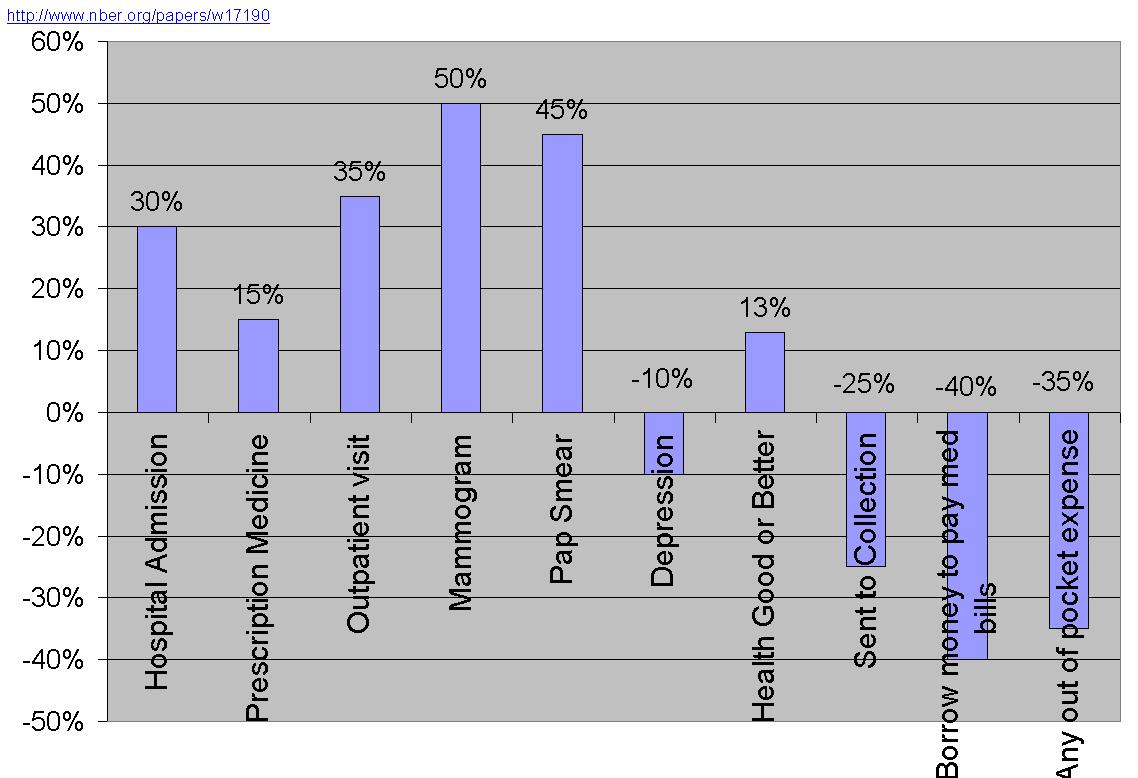


Click to enlarge.  Source 

Oregon realized it had resources to add about 10,000 beneficiaries to the Medicaid roles in 2008, and decided to hold a lottery to determine who would be awarded this Medicaid insurance.    89,824 Oregonians were eligible, 29.664 were randomized to be able to apply for Medicaid, and about 1/3 actually qualified.  (Reasons for not qualifying included not completing the paperwork or having income that was too high.).

Researchers at Harvard used this natural experiment to see what the impact of winning this Medicaid lottery really meant.   This natural experiment is ideal to determine the effect of gaining potential Medicaid eligibility – because the 30,000 who won the lottery (experimental group)  were randomly chosen, making it unlikely that they were significantly different than those who did not win the lottery (control group).

This is an especially important study because of the randomization, and because the researchers surveyed the experimental and control groups, and also looked at medical claims and credit reports to determine financial impact of insurance availability.


All of the conclusions are on an “intention to treat” basis – so that those who won the lottery but didn’t qualify for Medicaid are included in the “experimental” group. While this is necessary to make the “experimental: and “control” groups comparable, this approach likely  understates the effect of actually getting Medicaid because only 1/3 of the “experimental” group actually qualified for Medicaid.

What the researchers found

1)     People who won the lottery more care.  They don’t have fewer emergency department visits, they have more inpatient stays and outpatient visits.  It’s likely that there was some “pent up demand” from previous care foregone
2)     People who won the lottery have less life-changing medical debt. They are less likely to borrow money, and less likely to have a collection agency chasing them for medical debt.
3)     People who won the lottery get more preventive care
4)     People who won the lottery are more likely to report their health is good, and less likely to be depressed

The good news is that 16 million more Americans should be getting access to Medicaid as part of the Affordable Care Act.  There are, of course, two pieces of bad news.  Many states are chopping their current Medicaid programs, decreasing both eligibility and provider reimbursement.  Further, states are trying to wriggle out of their previous promises to expand Medicaid eligibility. Finally, many optimists though that having more people insured would lower medical costs – reasoning  that people could get treated early preventing high costs from detection of late stage disease.   The Oregon natural experiment is short – so it’s possible that this will become evident in the future. It’s unlikely though.   

Access to health insurance improves health and decreases financial stress.  It doesn’t save money. 

CMS 2012 Draft Payment Rules: Automatic Triggers Cause Huge MD Fee Cut


Today’s Managing Health Care Costs Indicator is $330 billion


The Centers for Medicare and Medicaid Services issued its draft 2012 payment rules yesterday. The  payment rules give modest increases to ambulatory facility fees, tie ambulatory surgery fees to quality reporting, and make some much-needed changes in imaging reimbursement.  

The headline is that these draft payment rules cut physician fees by almost a third, as required by the sustainable growth rate formula.   This is the automatic trigger that has been overridden by Congress every year (or more) since 2002.   Just about no one thinks this is a good idea.  Physician payment increases in Medicare have been substantially less than those offered by other payers, and in some communities it's hard to find a physician taking new Medicare patients.  

Click to Enlarge  Ginsburg, New England Journal 12/10 

The cost of physician services keeps on going up, and no efforts to lower utilization have worked - so the blunt instrument of threatened massive payment cuts continues to hang over physicians' heads.  The 10 year cost of eliminating the SGR payment cuts would be $330 billion.  

There's a lot of talk in Washington about establishing automatic triggers to prevent the government from overspending.   The SGR is an example of such an automatic trigger that has been in place for some time, through Democratic and Republican administrations and Congressional majorities.   We've proven in health care already that these triggers only work if they make sense and there is enormous political will to support them.  A singular problem with the SGR is that cutting physician unit payments is not an especially effective way to lower overall health care costs.

There has been an enormous amount of lobbying to reverse these cuts over the past decade.  We should expect a similar response to future cuts in government spending triggered automatically, especially those that don't make political or economic sense.

Screening CTs for Lung Cancer


Today’s Managing Health Care Cost Indicator is $674,000


Last week’s New England Journal of Medicine  reported a landmark study showing that screening low-dose CT scans really can save lives in people at high risk for lung cancer. 

The study is unequivocal – those who got screening CT scans were substantially less likely to die of lung cancer. Further, all-cause mortality was lower – even though a few people with CT scan screening died of exploratory surgery when they were found not to have cancer.

This study enrolled only smokers or ex-smokers with at least 30 pack years of smoking history, and excluded those who had signs or symptoms of cancer already, such as weight loss or coughing up blood.   It was peformed by the National Cancer Institute, and did not have funding from either companies that manufacture scanners or from tobacco companies.

The authors don’t recommend that all smokers and ex-smokers start getting annual CT scans.   Even with low dose scans, some cases of cancer are likely to result from massive screening – especially breast cancer in women. 

The level of “false positives,” abnormal CT scans that did not represent lung cancer, was stunningly high.  Over a quarter of study participants were found to have a scan suspicious for cancer in years one and two, and almost one in six in year three.  Only 1 in 20 abnormal CT scans suspicious of cancer actually showed a cancer. The control group received annual chest radiographs, and the CT scan group had a total of 119 excess cancers found – out of  18,146 suspiciously abnormal scans over the three year screening cycle.  That’s an increased case finding rate of 0.66% for the CT group compared to the radiography group.

Here’s the big public policy problem.   This study included 3 CT scans (at annual intervals) for just under 27,000 patients. At $1000 per scan, that would be a cost of over $80 million for the scans alone.  The cost of workup of all those false positives was substantially more.    The cost of just scans per incremental cancer found would have been $673, 664! ($80 million divided by 119) 

This study shows clearly why screening is unlikely to save dollars in the health care system.  The study took a group of high risk individuals – and even in this group, the false positive rate was quite high, and the cost per additional case found was very high.   

From a public policy perspective, we have to either
1)     Get scans that cost $100, rather than $1000.  We’ll need major disruptive innovation to allow that.
2)     Develop a more specific screening test, without losing sensitivity – so there won’t be 19 false positives for every true positive
3)     Develop less invasive followup tests to minimize the cost of pursuing the many abnormal tests

Of course, the best approach is to continue to levy high taxes on cigarettes, reinvigorate counter-marketing, and make cigarettes difficult for teenagers to obtain.  

Screening for lung cancer is not nearly as good as preventing lung cancer – and screening is far, far more expensive.