Showing posts with label Affordable Care Act. Show all posts

Affordable Care Act Insurance Company Rebates


Today’s Managing Health Care Costs Indicator is $1.93 billion


The Commonwealth Fund released a study today estimating that insurers would have had to refund almost $2 billion to employers and consumers in 2010 if the Affordable Care Act provisions requiring “medical loss ratios” of at least 80-85% were in place.    

The paper reviews MLR methodology  -and points out that the Affordable Care Act has a broader definition of medical cost than that traditionally used by actuaries – including quality and antifraud programs, excluding tax payments from consideration, and allowing for additional administrative cost for plans with very few members.  A number of states have received waivers – and the decreased rebates due to waivers is modeled in the calculations.

The rebates would have been highest in the individual market (53%; an average of $183 per policy), but lower for small group (24%; $85 per policy) and lowest for large group (15%; $72 per policy).  This is not necessarily because health insurance plans are fleecing individuals.  The MLR includes everything besides for claims costs paid to providers, and the marketing and administration costs are much higher for policies sold to individuals compared to policies where a single signature arranges insurance for hundreds or thousands of policyholders.

Some states already regulate MLR – and no insurers would have owed rebates for individual insurance in Hawaii, Rhode Island and Vermont, while 98% of the market would be owed rebates in Kentucky, and 95% in Arizona. Insurers representing 12% of the Minnesota market would have owed rebates, even though that state prohibits for-profit insurers. 

I wouldn’t expect that health care costs would have been $2 billion lower if the ACA had been in place in 2010.   There is considerable judgment in determining what is a medical cost and what is a nonmedical cost.  When insurer stock price soared with low MLRs, health plans were more likely to count slightly clinical services as nonmedical.  With regulations to prevent low MLRs, health plans will do all they can to move arguably nonclinical costs into the medical loss ratio.  

While the MLR ratio requirements won’t save as much money as suggested in this white paper – it does put pressure on health plans to reduce nonmedical costs.  That pressure will force tiny plans to consolidate, which will help them increase efficiency. It discourages health plan arms races that lead to inordinate investments in expensive marketing.  It is likely to put downward pressure on brokers’ fees– and lead to health plan products that are simpler to administer and need fewer explanations. This regulation pressures the individual health insurance market to deliver health care products that have far more value to health care consumers (aka patients.) 

That seems like a great idea to me.


Click on image to enlarge. Source 

A Tough Week


Today’s Managing Health Care Costs Indicator is Five


It’s been a tough week for health care wonks of my persuasion.  

The Supremes – or at least the all-important Anthony Kennedy – suggested that the individual mandate could be toast, which would mean that the Affordable Care Act would insure millions fewer Americans.  Scalia et al suggested that if the mandate fell, the Court should invalidate the entire law, which would mean years or decades before we start trying the many good ideas embodied in this bill – including a path to generic biologic drugs, more comparative effectiveness research, and pilots to bundle payment.   The ACA is imperfect – but is chock full of good ideas for how to improve value in health care.  Many of these ideas won’t work as well as we would hope – but if we aren’t experimenting responsibly, our health care cost crisis will just continue to get worse and worse.

We need five justices to uphold the mandate, or at least to fail to declare the entire ACA unconstitutional. 

Two studies that came out this week also heightened my sense of malaise.  

The Premier Medicare Pay for Performance pilot – in which a group of 252 hospitals could earn bonus payments for improving certain quality metrics – showed no effectiveness whatsoever in lowering 30 day mortality.  NOW- this project wasn’t aiming to lower mortality. The bonuses were to encourage higher scores in certain evidence-based quality metrics – such as use of beta blockers and aspirin for heart attacks  and rapid antibiotics for pneumonias.   The reasoning was that this could improve quality and lower costs.
 Click Image to Enlarge. Source 

There are a lot of reasons why the Premier Medicare project might not have worked

·      The quality metrics might not actually be associated with lower mortality (good ideas –but not effective at diminishing death rates)
·      30 day mortality might be a bad metric itself – perhaps the hospital has more control over 15 day mortality, or 45 day mortality
·      The risk adjustment could have been flawed
·      The incentive might not have been large enough. The incentive was distant from the action, and although there was a potential penalty, hospitals could drop out if they faced a penalty.
·      The communication with the thousands of medical staff of these hospitals might have been ineffective


But all of this is whining.  Bottom line – this is  a deeply disappointing study.    Kudos to CMS, Premier, and Jha et al for publishing these negative results.  The only way to move forward effectively is to publish both positive AND negative results.

Ashish Jha had a double header in the NEJM last week – he also had an editorial suggesting that the emphasis on preventing hospital readmissions might be misdirected.  Hospital readmissions are staggering in the US Medicare population (almost one in five in 30 days).  However, readmissions are much lower in those under 65.   Further, Jha points to a literature review from the Canadian Medical Association Journal (The JAMA of the North) that showed that with clinical record review less than 12% of readmissions were judged to be preventable.  Overall only 2.2% of discharges led to a preventable readmission in this literature review.  Jha points out that penalties for high readmission rates could inadvertently penalize hospitals with lower mortality rates (who discharge patients who are by definition sicker).  Emphasizing the “wrong” measure draws our attention from other areas that may lead to better outcomes or more cost savings.

Now that we see coherent arguments against focusing too much attention on the “core measures” in the Premier demonstration and readmission rates, we just have to identify  on which metrics we SHOULD focus our attention.

The Continued Decline of Employer-Sponsored Health Insurance


Today’s Managing Health Care Cost Indicator is 53.5%


Click on image to enlarge. Source http://hschange.org/CONTENT/1280/
A report from the National Institute for Health Care Reform this week reports that 53.5% of Americans under 65 were covered by employer-sponsored health insurance in 2010 – a startling 10 point drop over only four years.  This continues a long term trend – almost 70% of Americans were covered by employer-sponsored health insurance in 2001. 

Employer-sponsored health insurance can decline for three reasons

  1.      Fewer people have been employed.
  2.      Fewer employers might offer health insurance.
  3.      More employees might decline employer-sponsored insurance, usually due to high employee premiums.


The Great Recession has reshaped all three elements of the employer health insurance market.  It will take us years (or decades) of growth to get back to employment levels that would have been predicted pre-Recession – and fewer jobs for applicants has meant a labor market where employees have more readily accepted poorer benefits – grateful just to have a job.   

More employees are working as independent contractors rather than full employees – and therefore ineligible for employer benefits.  Further, employers have felt enormous pressure to lower their costs –and with benefits (largely health insurance) often running an additional 30% of payroll, many employers have offered plans with lower benefits and higher employer premiums.  The higher premiums mean that more employees will opt-out –and be uninsured.

Government-sponsored insurance has picked up a substantial portion of the slack. Medicaid has increased from 9.5% of the population to 17.6% from 2001-2010, and even Medicare coverage has increased from 1.6% to 3% of the population (presumably more Americans who qualify for disability).    Still, the uninsured went from 14.1% to 19.5% of the population. (The 15% usually cited includes the elderly, who are nearly universally covered by Medicare).


Employers are advantaged purchasers of health insurance. They have a ready-made and stable group (sothey can spread risk across the population, and  it’s easier for actuaries to estimate future costs.)  They can enroll employees and families easily – lowering transactional costs compared to health plans enrolling individuals and small groups.

But employer-sponsored health insurance also causes “job lock,” where those with serious illness in their family are unwilling to change jobs for fear of insurance interruption.  This decreases labor flexibility – lowering overall growth and productivity. 

The decline in employer-sponsored health insurance illustrates the importance of establishing other ways to obtain health insurance.  These alternative means should have low transactional costs, and should allow substantial spreading of risk over the population.  That’s why we need health insurance exchanges to maintain access to health insurance and health care, and an individual mandate (or something close) to discourage the healthy from opting out.  

The nature of employment in the US has changed substantially, and the ACA allows the insurance market to effectively respond to these changes.  We’ll see what happens this week during Supreme Court arguments over the constitutionality of the Affordable Care Act.

Perceptions of the Affordable Care Act


Today’s Managing Health Care Costs Indicator is 44%


Click on image to enlarge.   Source 


The Kaiser Family Foundation does periodic tracking surveys, asking Americans for their opinion of the Affordable Care Act.  The January survey showed that 44% of the public regard the bill unfavorably, while 37% regard the bill favorably. 

KFF explored the percent of nonelderly who would benefit from the ACA by PUMA (Public Use Microdata Areas – a bit larger than zip codes).    Interestingly, Republican congressional districts got substantially more benefit than Democratic congressional districts. 


On average, an estimated 17% of the non-elderly population nationwide would benefit from the Medicaid expansion and tax credits. In parts of Florida, New Mexico, Texas, Louisiana, and California, 36-40% of population could benefit.  In areas of Massachusetts, Hawaii, New York, and Connecticut – states that generally have high levels of employer-provided health insurance or have already implemented reforms to make insurance more accessible and affordable – 2-4% of the non-elderly could benefit from the coverage expansions in the ACA.


Click image to enlarge.  Source

Harold Pollack had a thoughtful essay in The Incidental Economist, debunking some of the right wing press which misstates conclusions from Jonathan Gruber who evaluated impact of the ACA in Wisconsin, Minnesota and Colorado.   He concluded with a question:

Millions of people will join health insurance exchanges. Most will be relatively healthy. They will see certain relatively small and immediate things, such as contraceptive coverage and clinical preventive services. They will not (yet) experience chronic illness and thus the resulting interactions with their insurer. Will they perceive and value the improved actuarial value of this insurance? Two years ahead of time, it is impossible to answer this basic question.

I don't feel sanguine about this.  The fact that Gruber and others show that on the average households will be better off doesn’t mean that the Affordable Care Act will be popular.  Distribution of benefits from the ACA and our understanding of behavioral economics gives us some reasons to worry

1.     The Affordable Care Act includes defines essential coverage, which will prevent insurers from selling policies that would not cover preventive care.   Many people won’t realize that the preventive care wasn’t covered before (especially if they had HMO policies which traditionally cover such services.) Most employer policies cover preventive care already.  
2.     Medicare cuts in future hospital reimbursement increases are necessary – and there is no credible health care reform plan that does not include such cuts.  However, these cuts will be blamed every time a hospital has a layoff  - and might be highlighted whenever a patient has access difficulty.  This is a framing problem – the ACA will be compared with what we had before 2010 – not what we would have had instead.
3.     The ACA’s prohibition against underwriting for kids and against excluding preexisting illnesses will provide much-needed new benefits to a very small number of people.   Most of those with employer-based insurance already have this.  Many who had previously purchased defective coverage – which would not have protected them if they had a major illness – value their current low premium, which will increase under the ACA.   They will in the future have an insurance plan that is a  “Chevy” rather than a Yugo with a defective engine block – but they didn't realize their old policy was defective if they were in good health.  They liked the low premium for the Yugo though!
4.     The ACA only allows a three-fold difference between the price of coverage for the oldest vs. the youngest health plan beneficiaries.  This means that there will be substantial subsidization of the old by the young.  That might seem politically good (middle age people vote in higher numbers than the young).  However, people hate losses much more than they like gains.  Therefore, the “losers” in the new system will be much more unhappy than the “winners” will be gleeful.
5.     We tend to like what we already have (“Endowment Effect,”) and many people will lose their current policies. They might get better policies – but still change is unpopular.
6.     We also tend to like choices.   While there will be more choices in health insurance exchanges (assuming that each state has a functional exchange) than the current choices available to individuals and small groups – there are mandates now which limit individual choice.
7.     2012 had relatively low rates of health care premium inflation. If that inflation rate is higher in 2013 or 2014, many will blame the ACA – even if actuaries know that the incremental requirements are responsible for only a tiny portion of overall health care premium inflation.


There are a few concepts from behavioral economics to suggest how the Obama administration should approach the political conundrum of gaining more public support for the ACA

1.     Discounting: Be sure to show the benefits as soon as possible.  We discount too much in our minds -  so a benefit in the distant future is like no benefit at all.  2014 seems like an eternity away right now, and the uncertainty around the Supreme Court challenge makes this problem worse.  (The KFF survey showed that the majority of Americans think the Supreme Court will find the individual mandate unconstitutional).  Coverage of young adults on their parents’ policies was an excellent idea.
2.     “Availability”.  We really like stories – much more than facts or statistics.  Therefore, we need more stories about families with hemophiliac kids no longer facing ruin because of lifetime limits, and families covered for dramatically less than they had to spend prior to health care reform.
3.     We overestimate the chances of small-likelihood events – which is why we gamble and play the lottery. It’s also why we worry about being killed in  a plane crash. (Cars kill over 40,000 per year; in the average year the deaths from civilian air crashes with scheduled carriers is less than a dozen).  The Affordable Care Act would protect Americans from terrible outcomes from rare events.   We need to hear more about this.

The Affordable Care Act will be good for the average family – and over time should be quite good for our economy.   But many will continue to doubt the overall benefits of the ACA – and we need an effective political campaign to show its benefits.

Commonwealth Fund Identifies Income Divide in Health Insurance Access


Today’s Managing Health Care Costs Indicator is 35%

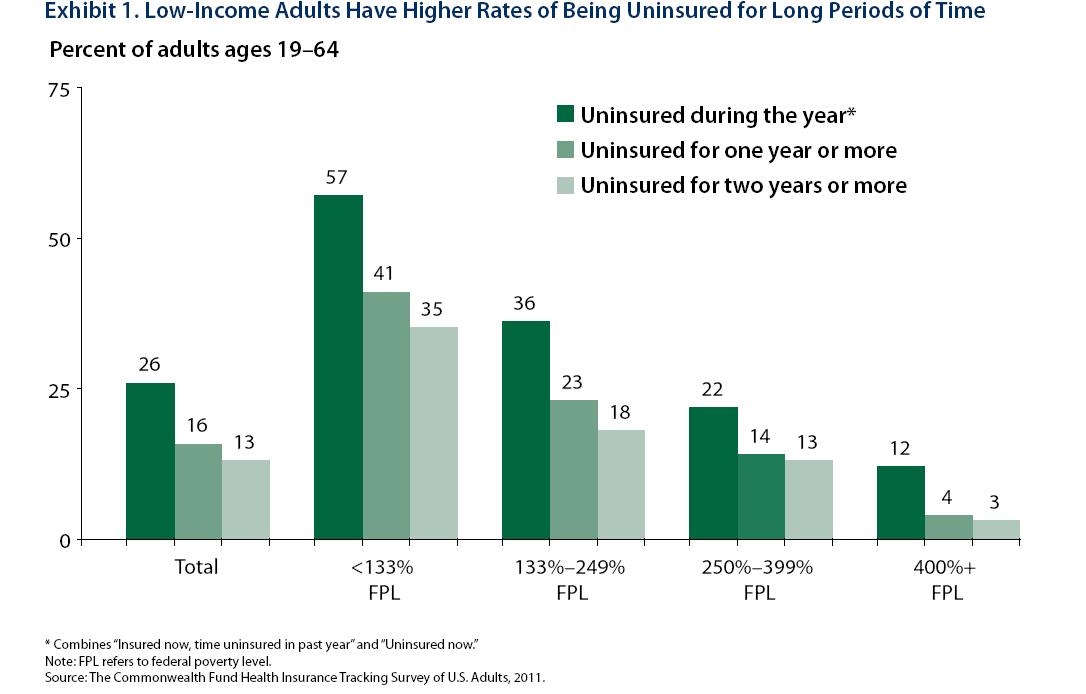
Click on image to enlarge.  Source 

Yesterday, I  told two stories demonstrating the danger  the current health care financing system poses to those with serious chronic illnesses – threatening them with loss of coverage and 

The Commonwealth Fund published its tracking survey yesterday, which demonstrated that the economically disadvantaged face the same type of challenges in obtaining coverage and care.  Adults who are poor (<133% of federal poverty level) are much more likely to be uninsured. The likelihood of being uninsured for the entire previous two years was 35% among those at <133%FPL, compared to only 3% of those with income >400%FPL.   Overall likelihood of being uninsured for some time over the previous two years was 26% for the entire sample – but this ranged from 57% (<133% FPL to 12% (>400% FPL).  The study included over 2100 respondents, and was adjusted to be a nationally representative sample. 

The Commonwealth Fund study also noted:
·        28% of all respondents were seen in an Emergency Department over the last year. Those who were uninsured during the year were more likely to report going to the ED because they needed a prescription (50% vs. 35%), because they did not have a regular physician (41% vs. 16%), and because they believed that other sites of care cost too much (40% vs. 20%)
·        Those who were uninsured during the year were five times less likely to have colon cancer screening (10% vs. 50%). They were twice as likely not to receive a mammogram (32% vs. 66%)
·        Those who were uninsured said they skipped colon cancer screening because it was too expensive six times more frequently than those who maintained insurance all year. (33% vs. 5%)
·        Almost 2/3 of those with income <133% FPL depended on Medicaid or SCHIP to obtain health coverage (63%), but they were still most likely to have at least one child uninsured (31%, compared to 19% overall)

Income insecurity has gone up dramatically in the United States over recent years.  Few companies continue to offer defined benefit pension plans, and companies are exiting retiree health.  It’s hard for anyone to get a job, and for those without advanced degrees it’s harder still.  Employers are eyeing the expense of their health insurance plans carefully, and considering decreasing their investment to avoid the 2018 “Cadillac tax” nationally, and because they are competing in a world market with companies located in countries where employers don’t foot the bill for healthcare.

The Commonwealth Study shows that health insecurity is a frequent complication of economic hardship.  This leads to low value patterns of health care consumption, including unnecessary ED visits and foregone preventive care. The Affordable Care Act should reduce the coverage problem substantially starting in 2014, as the federal government provides premium support, and assuming the states establish exchanges to make it easy and (relatively) cheap to purchase health insurance. Lack of access to health insurance leads to poorer medical outcomes – including cancers unnecessarily diagnosed at a late stage.   We need the Affordable Care Act and its provisions that will make it far easier for Americans to obtain health insurance coverage.

Day Five of Good News: Health Care Fraud


Today’s Managing Health Care Costs Indicator is $3 billion


Health care fraud is rampant and unconscionable.  Fraud fighters have made real progress in the last year.  

Many commentators think 10% or more of total health care costs represent actual fraud – as much as $250 billion a year. We’re not talking about honest mistakes (such as billing for a C-section that was necessary and actually performed but using the wrong code). We’re not talking about ‘abuse,’ such as billing for a laboratory test that was actually performed but medically necessary.  We’re talking about downright heists, like setting up a fake laboratory company, purchasing patient Medicare numbers, billing and collecting reimbursement, and shutting down the operation before anyone asks any questions. (Great Reuters story about these phantom firms at this URL)

The good news is that health care fraud is becoming more difficult due to aggressive enforcement action by the federal government, many state governments, and many private health plans.  The Department of Justice has had the second year of record settlements, including a $3 billion settlement with Glaxo Smith Kline for improper marketing of the diabetes drug Avandia, which has been associated with increased risk of heart failure.


  1. Here’s why I believe health care fraud will decline in the coming years
  2. New dollars for fighting health care fraud as part of the Affordable Care Act.  
  3.  Improved technology to detect fraud before payment, and willingness to submit claims to preadjudication audit. Medicare and health plans historically paid bills and then “chased” fraudulent providers after the fact. In many instances, that was simply too late
  4. Transition to bundled payment, which is less amenable to fraud than fee for service
  5.  Increased transparency – which will make some of the egregious cases visible to journalists who can start the investigation ball rolling

Here’s a list of pending health care fraud settlements from an advocacy group, Taxpayers Against Fraud.  

Health care represents such a large part of the economy that it will never disappear.  However, I believe that current efforts are already paying off.

Affordable Care Act and Pharmacy Savings


Today’s Managing Health Care Costs Indicator is $1.5 billion


I’ve been on the road early this week – where I see a lot more of USA Today. The top of the fold Tuesday trumpeted “Health Care Law Changing Behavior.”    The article itself mostly recounts pharmacy savings from the ACA, and briefly mentions full coverage for preventive care in some of the last paragraphs.

The article states that Medicare beneficiaries saved $1.5 billion this year (through August) because of the 50% discount on brand name drugs that are purchased within the “donut hole,” where cost of outpatient drugs are entirely the patient’s responsibility. The donut hole is between $2700 and $6154.  CMS states that the average saving was $569 per person.

Where did these savings come from?   The ACA included mandatory price cuts for seniors who are in the “donut hole,” and thus the funding for this comes from the brand name pharmaceutical industry.   This isn’t all a giveaway, though, by any means.   Lower priced brand name drugs for those on multiple prescriptions is a great deal if there are no generic equivalent.  However, generics tend to be 90% less expensive than brand names – so a 50% discount on a brand name remains a bad deal for seniors.

I suspect the $569 is the average savings for those who had any savings – because a bit over half of Medicare beneficiaries does not hit the $2700 in eligible outpatient pharmacy expenses.

The pharmaceutical industry made a deal early to support what became the Affordable Care Act.  PHaRMA agreed to some price concessions, but gained many more elderly with meaningful drug coverage. Out of pocket costs went down by more than 20% for seniors, leading to a bit over a 5% increase in overall drug utilization.    Marginal costs to produce drugs are very low- so these extra customers are very important to industry profitability.

Has there been behavior change?  Perhaps.  But the USA Today reporter didn’t probe very hard. Catch this quote.  

“Seniors are becoming more engaged in their care, [CMS director Jonathan] Blum said, citing the hundreds of forums Medicare has conducted about the changes.”

I’m guessing the benefit design of full coverage for preventive care might change behavior more than the hundreds of forums!

Mandatory Coverage of Contraception Could Increase Use of Expensive Agents


Today’s Managing Health Care Costs Indicator is $919.86

Click to enlarge. Source: Drugstore.com 

Full coverage of contraception should be a money-saver, as I noted in an earlier post.    However, my reading of HHS’s announcement makes me worried that the requirement for health plans to cover all contraceptives, regardless of cost, could lead to much higher use of less cost-effective birth control options.   

The new regulations require that  long-term contraceptive methods, such as an IUD, be fully covered, even though the woman might well be on a different health insurance plan a short while after receving this.  This is good from a societal point of view.  The long-term contraceptives (IUDs and depo-provera) are more reliable, since they don’t require users to take a pill or insert a device frequently. This increases effectiveness in real-world use, and these long-term agents tend to cost less over their duration than oral contraceptives.

Here's the worry with mandatory access to all contraceptives without patient cost-sharing.  There is a ten-fold difference in price between generic oral contraceptives and newer, heavily-marketed, branded oral contraceptives.   If insurance companies are mandated to cover each with no patient cost sharing, we could see a migration from cost-effective generics to newer drugs which cost far more and are not any more effective.  Further, when physicians prescribe these newer medicines, they don’t know whether broad community use will unearth side effects not recognized during limited pre-marketing testing.

My suggestion – the regulations should be clear that patient cost sharing is not allowed for generic oral contraceptives. Patient cost-sharing does lower utilization, and there are some costly medications which could otherwise increase the cost of health care.  Ideally, regulations should also set a maximum acquisition cost for longer term contraceptives to prevent massive future price increases.  

CMS Actuary Projects Future Health Care Growth


Today’s Managing Health Care Costs Indicator is 19.8%


Click to enlarge.  Source

Health Affairs published the 2011 CMS Actuary projections of health care cost growth over the next ten years, and there are some important observations.   As the report points out, these are projections – and the model has to make a series of assumptions, many of which are dependent upon the overall economy, changes in legislation and regulation, and provider reactions to payment reform.

Some of the conclusions:

·        The total spending on health care will almost double between 2008 to 2020, from $2.4 trillion to $4.6 trillion. 
·        Health care overall will increase at a rate about 1% faster than GDP growth.
·        Health care now represents 17.6% of the GDP, and will grow to 19.8% of the GDP by 2020.
·        The portion of health care expenditures that are government payments will approach 50% during this time period, and the federal portion of direct health care expenditures will increase from 27% to 31% 
·        Medicare increases due to aging population are substantially dampened by payment cuts of the Affordable Care Act
·        Eliminating the (unimaginable) SGR 29.4% physician payment cut scheduled for January 1, 2012  would mean that the Medicare increase would jump from 1.7% (substantially below GDP growth) to 6.6% next year.  The SGR elimination is not factored into the chart above – but it has the same impact on projections with or without the Affordable Care Act.
·        The impact of the Affordable Care Act is negligible until 2014, when there is a one-year bump in medical inflation due to the large number of Americans who will receive insurance
·        There are many “winners” in the 2014 payment bump:
·        Prescription drug spending would increase by 10.7%, more than double the increase without the ACA
·        Physicians (8.9% bump, about 1/3 increase)
·        Hospitals (7.2%, just a 1% increase, since many of the newly-insured are healthier than those who were habitually uninsured.

The total cost of increase in coverage is relatively modest, although I suspect both supporters and opponents of the Affordable Care Act will cite this study to support their point of view.   The pressure to constrain future growth in health care costs will continue unabated.

Public Health Spending Saves Lives


Today’s Managing Health Care Costs Indicator is 5%


Click to enlarge; * statistically significant  Source 


This week, Health Affairs  e-published research correlating higher local spending on public health with lower mortality.  The article points out that the US spends less than 5% of health care costs on pubic health initiatives, less than we spend on administrative overhead in health benefit claims.

Public health spending, which can include anti-smoking education, childhood and influenza vaccines, and sexually transmitted disease and prenatal education, increased in about 2/3 of communities from 1993 to 2005, and decreased in the remaining communities studied.   

From the article:
Communities with larger increases in public health spending experienced larger reductions in mortality from leading preventable causes of death over a thirteen-year period. This relationship was consistent across several different mortality measures, and it persisted after accounting for differences in demographic and socioeconomic characteristics, medical resources, and unobserved community characteristics that jointly influence spending and health. These findings are consistent with recent time-series studies estimating that, nationally, as much as 50 percent of the gains in life expectancy experienced in the United States since 1950 are attributable to public health attention to diet, tobacco exposure, and other measures

This study validates one of the elements of the Affordable Care Act, which includes an additional $15 billion in public health spending.  It also suggests that improving health of communities can lengthen life, and perhaps lower medical claims costs.

IOM Birth Control Decision: No Increased Medical Costs


Today’s Managing Health Care Costs Indicator is Zero


This week’s recommendation by the Institute of Medicine that birth control should be covered by health plans without patient cost-sharing is bound to cause political fireworks.  Groups that oppose abortion will object because some forms of birth control (IUDs and ‘morning after’ pills) interfere with uterine implantation after conception.  Religious groups will object that mandating that they cover birth control violates their religious doctrine.  Those who believe that patients should pay at least something for services to be sure they value them appropriately will object to birth control having no cost share at all.

I expect we’ll also hear complaints that this is an unfunded mandate – and one more way that health care costs will be increased by the Affordable Care Act.

However, these potential complaints appear to be unfounded. 

The HR consulting firm Mercer did a study in 2000 that showed that medical claims costs went down when employers covered contraceptives.  That’s because pregnancies and abortions are expensive – and oral contraceptive pills are not.  This study was done when many commonly-used birth control pills had not yet gone generic.    

The Washington Business Group on Health (now the National Business Group on Health) also did a study in 2001 suggesting that the direct and indirect cost of plans that did not cover contraception was 15-17% higher than plans that did.   This is because of short term disability claims due to pregnancy.

The federal government’s Office of Personnel Management found no increase in total cost of the federal Employee Health Benefit Plan when it started to cover birth control in 1999. 

These studies have all been cited extensively by those advocating for the IOM to recommend full coverage of birth control, including the National Women’s Law Center and the Guttmacher Institute.

Most mandates do increase the cost of health care.  Covering birth control, though, does not appear to raise overall medical claims cost.

Nash Equilibrium Returns: Industry Support for the Affordable Care Act Unravels


Today’s Managing Health Care Costs Indicator is $100 billion


One of the unheralded successes of the health care reform effort was to gain the support, or at least acquiescence, of major stakeholders who had opposed health care reform for decades. I called this the “Coalition of the Willing” at the time, after the various countries that not-so-willingly joined the American forces in Iraq in the George W. Bush administration.   Ultimately, the Affordable Care Act was supported by drug companies, the hospital and the physician lobby, medical device manufacturers, and health care unions. 

This broke a long-time “Nash Equilibrium,” where in a multiparty “game,” each party can see the others’ equilibrium strategy – and no player has enough to gain by changing strategy unilaterally.  It’s not easy to overcome the inertia of a Nash Equilibrium, and I was skeptical that the Obama administration could do this.

The agreements forged to support health care reform in spring, 2010, though, are fraying.

Politico  reported on Friday that the trade group representing brand pharmaceutical companies is lobbying fiercely to avoid having to offer Medicaid-style discounts to patients who are “dually eligible” for both Medicare and Medicaid.   Before Medicare Part D was enacted, Medicaid was the primary payer for these patients, who tend to be severely disabled or nursing home residents. 

However, Medicare Part D forced pharmas to take (low) Medicaid prices for drugs for this group of patients.  Part D was a giant pharma giveaway – enough that the Republican who managed the legislation, Billy Tauzin, became the head of the Pharmaceutical Research and Manufacturers of America (PhRMA) within months of the bill’s passage.  Current deficit reduction plans might eliminate the extra income from the dually eligible, which could lower the deficit between $50-100 billion over ten years.

The pharmaceutical industry came to the bargaining table for health care reform early, and agreed to chip in $80 billion in “savings”  for discounted brand name pharmaceuticals to senior citizens in the “donut hole” where Medicare Part D does not cover prescriptions.  However, its members were angry enough that Billy Tauzin left his position shortly after health care reform passed.

The medical device industry  also regrets its agreement to industry taxes, and is trumpeting that this element of health care reform could cost jobs and decrease innovation. 

The Wall Street Journal reported Monday that Democrats are furious at the hospital lobby, including local 1199, for its adds decrying suggested additional cuts in hospital payment as part of deficit reduction.  The hospital industry had agreed to substantial decreases in future pay increases as part of the Affordable Care Act, and it was fighting for more.

The American Medical Association supported the Affordable Care Act – but predicated its support elimination of the SGR, which caps total professional spending and would lead to a fee cut of over a quarter if not legislatively overridden at the end of this year.  The SGR remains – and the AMA’s top executive, James Maves, also headed for the door after health care reform passed.  There have been angry volleys from the AMA over recent MedPAC and HHS suggestions about how to change professional fees.

Nash equilibriums are very stable – breaking such a stalemate requires a compelling case that things will be much worse for stakeholders if they don’t agree to change.   That compelling case existed in early 2010 – but recent sniping leaves many in industry convinced that they could return to the pre-Affordable Care Act environment.   The costs of that system are unsustainable, but the pain of the savings to make the ACA work are daunting.  Industry will only support health care reform with a strong signal that the pre-ACA days will not return. That signal is not coming from Washington now. 

"Truthiness" and the Republican Presidential Debate


Today's Managing Health Care Costs Indicator is

 800,000

The Kaiser Family Foundation  has done us the favor of extracting the health questions from last night’s Republican presidential debate.

My take on the ‘truthiness’ of selected answers:

The Congressional Budget Office has said that Obamacare will kill 800,000 jobs.  -  Michele Bachman

The CBO estimated that the Affordable Care Act would slightly lower the overall cost of health care premiums for large employers, which could create new jobs.   It will be hard to create net new jobs in health care and lower health care costs.  Politifact  calls this “barely true” because the CBO noted that ½% of the workforce that works for health insurance only might choose not to work.

Obamacare….  took away $500 billion, a half-trillion dollars out of Medicare  - Michele Bachman
The Affordable Care Act cut future growth of Medicare by $500 billion over 10 years.  There is no way to cure the deficit without cutting Medicare’s future growth.  It’s not nearly the cut in future Medicare costs envisioned by the Paul Ryan budget plan.  It’s also not taking money from Medicare beneficiaries, but lowering future rate increases for providers.
We didn't raise taxes in Massachusetts. – Mitt Romney

We were lucky in Massachusetts to have over half a billion dollars in federal Medicaid waivers to help support health care reform.  We also did use additonal money from general tax revenue. There was no tax increase simply because the economy was in good shape and we had dollars available in the then-current tax base.
When you get into a mandate, it ultimately ends up with unconstitutional powers. –Newt Gingrich
The courts will ultimately decide.   The individual mandate was initially championed by conservatives.  It’s hard to avoid adverse selection and make insurance inexpensive for all without some penalty for not having insurance.  John McDonough has an excellent commentary reviewing this history.

If you're an average couple and you paid your entire amount into -- into Medicare, you would have put $140,000 into it. And in your lifetime, you will take out more than three times that much.  –Ron Paul

This is true.  Medicare is a good bargain because it costs less than commercial insurance, and a better bargain still for beneficiaries because there is a considerable subsidy.  Medicare is not fully funded by taxes directed to Medicare only.  Paul goes on to say that Medicare is “insolvent.”  It’s not really – it just will require decreasing costs or increasing tax subsidies.
We have to have more competition in medicine.  – Ron Paul
Michael Porter and others argue that we don’t need more competition – we need different competition.  We need competition among providers for meaningful bundles of services, rather than competition among health plans that don’t have enough impact on actual care delivery.
Why can't we opt out of the whole system and take care of ourselves?  - Ron Paul
Works when you’re healthy, can be deadly if you’re sick unless you have huge personal wealth!

My own plan… will feature performance pay rather than just volume pay to hospitals and clinics and providers.  –Tim Pawlenty  

Many agree that fee for service payment is a major problem leading to considerable provider-driven overutilization. This is a good idea, and I’ll await his plan eagerly.

[I] would allow… private contracting so those people who want to voluntarily could contract with their doctor or their hospital in addition to Medicare, and it would be outside the current system and it would relieve the pricing pressure on the current system.  –Newt Gingrich
Individuals contracting with their physician or hospital would have little leverage to lower prices, and the administrative costs of such a system would be hard to imagine.
 We think you can save $70 billion to $120 billion in Medicare and Medicaid annually by not paying crooks... –Newt Gingrich
Many suspect that fraud and abuse could be as much as 10% of medical costs.  Medicare and Medicaid together cost almost $900 billion, so this is possible.  However, it’s not as easy as it looks, and many who oppose regulation have a difficult time accepting the type of oversight that could be required.

I wholeheartedly support…a program that is identical to what seniors already have. It’s called Medicare Part D….[and it] is 41 percent under budget because seniors are involved in controlling costs – Rick Santorum
The Ryan Plan, which Santorum supports, is very different than Medicare Part D.  The Ryan plan would cap government expenditure, whereas Part D allows government costs to rise with medical inflation rate.  Medicare Part D is under budget not because of competition or seniors with “skin  in the game,” but because of generic drugs and much lower senior enrollment than projected.

The Independent Payment Advisory Board [is going to] ration care from top to bottom –Rick Santorum
There is a good thought article yesterday from the Concord Coalition , a center-right anti-deficit group, about why the IPAB is a critical part of health care reform.   We need to make tough decisions, and this approach is much like the way we deal with potential military base closings.