Showing posts with label Government Accountability Office. Show all posts

GAO: Diagnosis Code “Creep” Leads To Medicare Advantage Windfall


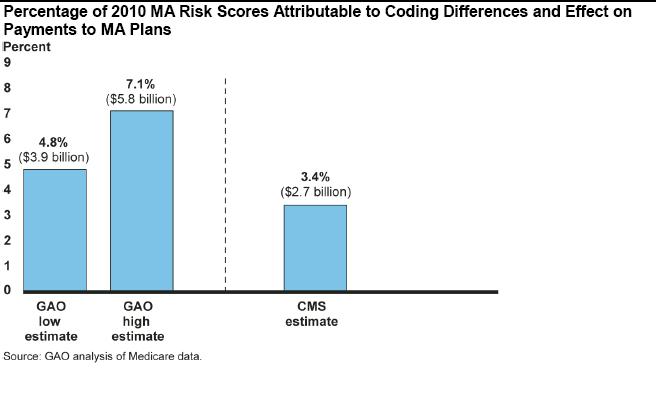
Today’s Managing Health Care Costs Indicator is $5.8 billion

Click on image to enlarge. Source

The General Accounting Office reported last week that Medicare Advantage (MA) plans, the private health plans that care for one in five Medicare beneficiaries, receive a windfall because of their effectiveness at coding member illnesses.  This is a quandary – capitation for Medicare members is only reasonable if there is careful risk adjustment. The Deficit Reduction Act of 2005 required risk adjustment to be phased in by 2010. 

Physicians in Medicare Advantage plans have a strong incentive to use coding to maximize the apparent illness of their patients.  Physicians in traditional Medicare are paid only based on services provided, so they have little incentive to aggressively code diagnoses.  As a result, the apparent severity of illness of Medicare beneficiaries who have chosen the private plans has increased dramatically faster than the severity of illness of Medicare beneficiaries on traditional Medicare.

It’s actually a bit worse than that. The Medicare Advantage plans put an enormous amount of energy into coaxing their participating physicians to aggressively code comorbidities during 2007-2009.  Here’s an example of how much it’s worth.  The Medicare payment goes up by 16% for diabetics, but goes up by over 50% for those who also have evidence of kidney or blood vessel involvement.   Mild diabetic kidney disease is quite common, but was rarely coded before risk adjustment.  Now, physicians participating in Medicare Advantage know that they must use the ICD9 code for diabetes with renal manifestations (250.4) at least every other year, or they will not get the maximum Medicare budget.   

Here are Medicare risk adjustment factors associated with diabetes. (See HCC_Coefficients_2009-2012)   Note that multiple comorbidities allow an additional upward adjustment, further encouraging more aggressive coding.
Click on image to enlarge.  Source 


CMS has been aware of this for some time, and as a result the agency has lowered all reimbursement to MA plans by 3.4% ($2.7 billion).  However, the GAO analysis suggests that the increased costs associated with aggressive coding are between 4.8% ($3.9 billion) and 7.1% ($5.8 billion).  

Across-the-board cuts to reimbursement to counteract differential coding aggressiveness means that all physicians associated with MA plans have to work even harder to be the most aggressive at coding complications.  If they merely code the same way as physicians participating in traditional Medicare, their reimbursement will fall each year.

The conclusion from a recent FTC analysis of gaming of risk adjustment:

Before risk adjustment, MA plans had an incentive to enroll individuals who were low cost, both along dimensions that will later be included in the formula and those that will not. Because risk adjustment increases payments for individuals with the conditions included in the formula and decreases payments for those with few or no conditions, risk adjustment lowers the payments MA plans would receive for these individuals, as they were selected to have low risk scores.

But in response to the new incentives created by risk adjustment, selection patterns into
MA change. After risk adjustment, MA plans have less incentive to avoid individuals with
the conditions included in the formula but have a greater return to enroll individuals who
have low costs conditional on their risk score. Indeed, relative to individuals who remain in FFS…MA enrollees' risk scores increase after risk adjustment, but their costs conditional on their risk score fall so much that, if anything, MA enrollees have lower total costs after risk adjustment.

There is no easy answer to this problem.  MA plans would seek the lowest risk Medicare beneficiaries if there were no risk adjustment.  However, they will seek to maximize the proceeds of risk adjustment when it is in place, and seek to select low-risk beneficiaries based on measures that are not included in the risk adjustment.  At a minimum, CMS should rebalance the risk adjustment “code creep” factor each year.  Further, CMS should consider applying this factor differentially to groups that have a high level of apparent “code creep.”  It’s possible that this could be done using ceilings on annual adjustments by group, exempting groups with very small or much-changed membership.  

The sad fact is that it’s easier to code aggressively than perform more effective medical management on the Medicare population.

Don Berwick’s Impossible Job


Today’s Managing Health Care Costs Indicator is $509 billion


The General Accounting Office offered testimony today to Congress about why Medicare is a government program at “High Risk.”  They’re right – Medicare costs the government (us)  $509 billion annually, and doesn’t have the infrastructure or the regulatory latitude to do a superb job of improving health care.  CMS Administrator Don Berwick doesn’t have the tools to change this.

The GAO observed
·        10.5% rate of improper payment on the fee for service business (and 14.1% rate of improper payment to Medicare Advantage plans)
·        Large-scale fraud in home health care
·        Overspending on oxygen therapy
·        Inadequately vigorous oversight of nursing homes

Here are the GAO’s recommendations:

  1. Implement an effective physician profiling system
  2. Better manage payment for imaging (such as radiology)
  3. Reduce fees when appropriate as technology lowers provider resource costs
  4. Readjust the GPCIs – the geographic payment adjustments for rural providers
  5. Improve contract oversight (including better review of claims at high risk of fraud and better nursing home oversight)

This is all sensible.  Fraud is certainly a problem in Medicare, and the feds have been late to move to predictive modeling and automated approaches to ascertain potential fraud. There is huge variability of care.  Imaging costs too much.   Payment differentials among areas don’t make economic or clinical sense, and while specialty societies go to the RUC (Relative Value Scale Update Committee) to complain about under-reimbursed procedures, but no external party keeps eyes out for over-reimbursed procedures.

But how realistic is this? Can CMS Administrator Don Berwick effectively follow the GAOs gameplan to make Medicare more effective?

Medicare can profile physicians, and has a large enough penetration of most adult practices that the profiling would be better than most.   BUT – legislation requires that Medicare offer participation to any willing provider. Physicians can be removed for the program for fraud – but not for inefficient resource use.  There is no ability to change benefit design to encourage Medicare members to go to higher value providers.  So it’s not clear that Medicare has the leverage to make profiling meaningful.   It’s also a huge job that ideally requires substantial engagement of practicing physicians – and Medicare isn’t resourced for this.

Medicare has lowered radiology professional fees substantially – but of course radiologists and hospitals oppose any fee concessions.   Reducing fees to account for efficiencies in technology means there will be losers. Those who get a financial haircut are almost always vocal. 

The GPCIs, and even local fee schedules, have long been micromanaged by members of Congress.  I’ve noted before that Ted Stevens obtained a permanent 35% rate increase for Alaska Medicare providersbo just before he left the Senate.     

CMS has been improving the oversight of contracts, but doesn’t have the staff to do more nursing home site visits. Separately, the GAO noted that bundled payments (such as for transplants) are administered by private health plans, but CMS doesn’t have the case management infrastructure to do this for Medicare beneficiaries.


A few ideas:

·        We should acknowledge that as much as we hate to see dollars spent on administration, Medicare’s administrative budget is too small for a program of its size. 
·        Congress needs to back off – and leave determination of prices to bureaucrats who can implement rules
·        We need to resource the RUC to do independent evaluations, as opposed to relying on testimony from specialty societies.

We need to be patient.  For its size, Medicare is remarkably effective at procuring care for our elderly and disabled. Its inflation rate has been consistently lower than the overall market (although to some extent this represents cost shifting to the private market).   Medicare has been run by able folks – both in Republican and Democratic administrations.  But they need a little more leeway, and some time to get the Medicare house in order.