Showing posts with label Commonwealth Fund. Show all posts

Affordable Care Act Insurance Company Rebates


Today’s Managing Health Care Costs Indicator is $1.93 billion


The Commonwealth Fund released a study today estimating that insurers would have had to refund almost $2 billion to employers and consumers in 2010 if the Affordable Care Act provisions requiring “medical loss ratios” of at least 80-85% were in place.    

The paper reviews MLR methodology  -and points out that the Affordable Care Act has a broader definition of medical cost than that traditionally used by actuaries – including quality and antifraud programs, excluding tax payments from consideration, and allowing for additional administrative cost for plans with very few members.  A number of states have received waivers – and the decreased rebates due to waivers is modeled in the calculations.

The rebates would have been highest in the individual market (53%; an average of $183 per policy), but lower for small group (24%; $85 per policy) and lowest for large group (15%; $72 per policy).  This is not necessarily because health insurance plans are fleecing individuals.  The MLR includes everything besides for claims costs paid to providers, and the marketing and administration costs are much higher for policies sold to individuals compared to policies where a single signature arranges insurance for hundreds or thousands of policyholders.

Some states already regulate MLR – and no insurers would have owed rebates for individual insurance in Hawaii, Rhode Island and Vermont, while 98% of the market would be owed rebates in Kentucky, and 95% in Arizona. Insurers representing 12% of the Minnesota market would have owed rebates, even though that state prohibits for-profit insurers. 

I wouldn’t expect that health care costs would have been $2 billion lower if the ACA had been in place in 2010.   There is considerable judgment in determining what is a medical cost and what is a nonmedical cost.  When insurer stock price soared with low MLRs, health plans were more likely to count slightly clinical services as nonmedical.  With regulations to prevent low MLRs, health plans will do all they can to move arguably nonclinical costs into the medical loss ratio.  

While the MLR ratio requirements won’t save as much money as suggested in this white paper – it does put pressure on health plans to reduce nonmedical costs.  That pressure will force tiny plans to consolidate, which will help them increase efficiency. It discourages health plan arms races that lead to inordinate investments in expensive marketing.  It is likely to put downward pressure on brokers’ fees– and lead to health plan products that are simpler to administer and need fewer explanations. This regulation pressures the individual health insurance market to deliver health care products that have far more value to health care consumers (aka patients.) 

That seems like a great idea to me.


Click on image to enlarge. Source 

Commonwealth Fund Sees Medicare Savings From PCP Fee Increases


Today’s Managing Health Care Costs Indicator is 2%

                     
The Commonwealth Fund  projects that Medicare investing through maintaining the Affordable Care Act’s 10% primary care physician increase beyond expiration in 2016, Medicare could save almost two percent of total costs.  In this simulation, primary care costs would go up by $89 per person per year (about equally distributed between increased unit costs and increased utilization), while total costs would decrease by $539 – a whopping 6:1 return on investment.

The authors posit that savings would come from hospitals and outpatient hospital facility fees and specialist care. Imaging and diagnostic costs increase in this simulation, which seems unlikely, as specialists seem as happy to order tests as primary care physicians. Outpatient medications and other Part B services also increase.

The authors make a powerful case to make more investments in primary care. The savings could presumably increase further if the primary method of payment was not fee for service.


Click on image to enlarge. Source link above


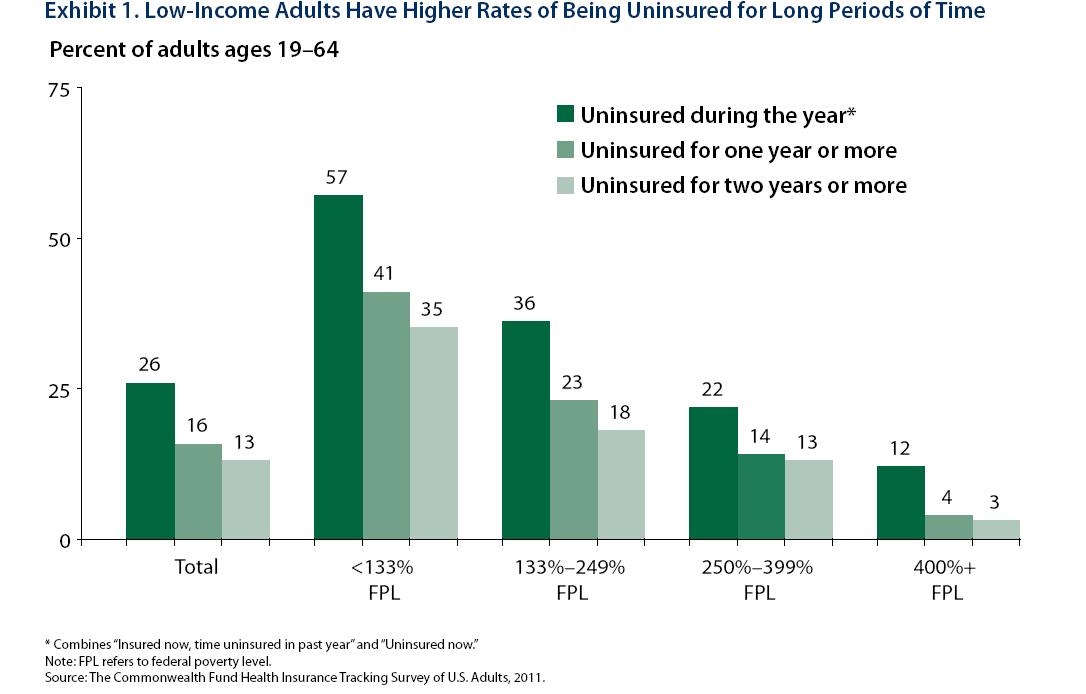
Commonwealth Fund Identifies Income Divide in Health Insurance Access


Today’s Managing Health Care Costs Indicator is 35%

Click on image to enlarge.  Source 

Yesterday, I  told two stories demonstrating the danger  the current health care financing system poses to those with serious chronic illnesses – threatening them with loss of coverage and 

The Commonwealth Fund published its tracking survey yesterday, which demonstrated that the economically disadvantaged face the same type of challenges in obtaining coverage and care.  Adults who are poor (<133% of federal poverty level) are much more likely to be uninsured. The likelihood of being uninsured for the entire previous two years was 35% among those at <133%FPL, compared to only 3% of those with income >400%FPL.   Overall likelihood of being uninsured for some time over the previous two years was 26% for the entire sample – but this ranged from 57% (<133% FPL to 12% (>400% FPL).  The study included over 2100 respondents, and was adjusted to be a nationally representative sample. 

The Commonwealth Fund study also noted:
·        28% of all respondents were seen in an Emergency Department over the last year. Those who were uninsured during the year were more likely to report going to the ED because they needed a prescription (50% vs. 35%), because they did not have a regular physician (41% vs. 16%), and because they believed that other sites of care cost too much (40% vs. 20%)
·        Those who were uninsured during the year were five times less likely to have colon cancer screening (10% vs. 50%). They were twice as likely not to receive a mammogram (32% vs. 66%)
·        Those who were uninsured said they skipped colon cancer screening because it was too expensive six times more frequently than those who maintained insurance all year. (33% vs. 5%)
·        Almost 2/3 of those with income <133% FPL depended on Medicaid or SCHIP to obtain health coverage (63%), but they were still most likely to have at least one child uninsured (31%, compared to 19% overall)

Income insecurity has gone up dramatically in the United States over recent years.  Few companies continue to offer defined benefit pension plans, and companies are exiting retiree health.  It’s hard for anyone to get a job, and for those without advanced degrees it’s harder still.  Employers are eyeing the expense of their health insurance plans carefully, and considering decreasing their investment to avoid the 2018 “Cadillac tax” nationally, and because they are competing in a world market with companies located in countries where employers don’t foot the bill for healthcare.

The Commonwealth Study shows that health insecurity is a frequent complication of economic hardship.  This leads to low value patterns of health care consumption, including unnecessary ED visits and foregone preventive care. The Affordable Care Act should reduce the coverage problem substantially starting in 2014, as the federal government provides premium support, and assuming the states establish exchanges to make it easy and (relatively) cheap to purchase health insurance. Lack of access to health insurance leads to poorer medical outcomes – including cancers unnecessarily diagnosed at a late stage.   We need the Affordable Care Act and its provisions that will make it far easier for Americans to obtain health insurance coverage.

A Plethora of Good News?


Today’s Managing Health Care Costs Indicator is $275 billion


Click on image to enlarge.  Source 
I wrote earlier this month that health care costs are rising less quickly than anticipated – due largely to the effects of the recession and substantially less generous insurance plans that leave patients shouldering a much higher portion of the total health care bill.  The CMS Office of the Actuary published data in the January Health Affairs that documents this.

Today’s Boston Globe (subscription required) reinforces this:

State regulators have approved premium increases averaging 2.3 percent for health insurance covering hundreds of thousands of residents, the most modest hikes in at least a decade and a sign that years of efforts to control costs may be working.

 
The Commonwealth Fund has calculated that the recent changes in the CMS estimate of total health care costs indicate that total health care costs will be $275 billion less in 2020 than estimated previously this year.   Health care costs are now estimated to be 19.8% of GDP in 2020; they were estimated to be 21.1% before health care reform was passed (and before we knew the depths of the Great Recession.

These pieces of good news are the direct result of the grim economy.  However, Austin Frakt of The Incidental Economist had an optimistic commentary last Wednesday entitled “How a health care efficiency revolution could make the next century even greater than the last.”

I’ve started a comment string with 5 factors that make it more likely we’ll welcome disruptive innovation in health care in the coming years, which can lower health care costs and increase value.  Austin added 6 more – and the list is now up to 16.  Go to this link to read the initial commentary and please add additional reasons (or object to those already posted.)  

The Cost of Doing Nothing


(Click on image to enlarge graph)

Reed Abelson has an excellent essay in today’s New York Times –making the case that the alternative to health care reform is NOT what we’ve got right now, since what we have right now is getting too ruinously expensive with each passing month.  Abelson reproduces a Commonwealth Fund chart (above) showing estimates of how much less of our GDP we would have been spending on health care if only we had succeeded at reforming health care in the Clinton, Carter, or Nixon administrations.

This is the right way to frame the health care reform debate to break the “Nash Equilibrium” that leads to gridlock.  Obama has tried to do this too, pointing out that if we wanted an health care systemn where every 10 years the costs doubled and 15% of our population was uninsured and much more felt at risk, we should oppose health care reform.  This framing hasn’t stuck, though, and the public (at least in most polling) doesn’t have the sense of urgency that many health care economists and public policy wonks see.

The Washington Post notes that interest groups are gearing up for the fight on health care reform – and pretty much everyone besides for the AARP is hiring lobbyists, shooting commercials, and protecting their turf.   This suggests that stakeholders deeply believe health care reform can be defeated –so they’re not likely to be willing to accept substantial changes (yet).

 Michael Kinsley notes that both sides of the health care reform debate are missing an important point (also in today's TImes)

Neither side has really grappled with the cost issue. When Aunt Minnie back in the district has a hip replacement (her second) and gets a bill for $90,000, the challenge is not to find someone other than Aunt Minnie to pay. The challenge is to deliver hip replacements for less than $90,000, or tell Aunt Minnie she can’t have one. 

We really need to transform the delivery system – changes in health plan benefits, health plan administration, and payment methodologies alone will not get us to the health care system our patients deserve.


The Commonwealth Fund and the Congressional Budget Office recently released competing estimates of the impact of various interventions on the federal deficit. The Commonwealth Fund's report is also explicit about the impact of these initiatives on overall health care costs - which is not the focus of the CBO report. I've pulled out five initiatives
1) Medical Home
2) Accelerate Health Care IT Adoption
3) Estabish a Center for Comparative Effectiveness
4) Increase tobacco tax
5) Place tax on sweetened beverages
The CBO suggests each of these will cause modest increases in the federal deficit, while the Commonwealth Fund analysis (performed by the Lewin Group) sees pretty substantial deficit reduction. The Commonwealth Fund's analysis is more in line with the budget proposed by the Obama administration.

I'm skeptical of the CBO's contention that raising taxes on sweetened beverages and tobacco will actually RAISE the federal deficit slightly. But it's important to note that the CBO's calculation of impact of the Clinton Health Plan on the federal deficit played a role in that plan's defeat. (See "The System" by Broder)

Keep your eyes on the Congressional Budget Office!